Top 10 Crystal Chandeliers Online for 2026

Top 10 Crystal Chandeliers Online for 2026
One of you is standing on a dining chair with a tape measure stretched to the ceiling box. The other is at the laptop, three tabs deep, comparing ceiling height, fixture width, and delivery dates before twelve guests arrive on Saturday night.
If you have ever tried shopping for crystal chandeliers online, that scene probably feels familiar. The hard part is not finding sparkle. It is choosing a shape that fits your room, hangs at the right drop, arrives on time, and still looks right once the boxes are open. A beautiful photo can hide a lot — especially over a 60-inch table or inside a two-story foyer.
This guide is for shoppers who want a cleaner path through the noise: families refreshing a dining room, couples finishing an entry, and homeowners trying to add polish to a kitchen island without turning the return process into a second job. The search results for this category are dominated by navigation pages from retailers such as Shades of Light and LightsOnline, so the smartest way to compare is by room and style family, not by pretending one fixture type wins every house from Boston to Brisbane.
That is also how I would shop it in real life. After enough rushed installs, late-delivery headaches, and rooms that looked perfect on paper but wrong from the doorway, I trust room fit, scale, and retailer support more than glamour shots.
Selection criteria for crystal chandeliers online
Start with the room: dining room, foyer, kitchen island, or small space
Watch This Helpful Video
To help you better understand crystal chandeliers online, we've included this informative video from Country Road TV. It provides valuable insights and visual demonstrations that complement the written content.
When you start with the room, bad options disappear fast. Shades of Light organizes chandeliers by style and placement, including modern & contemporary, transitional, traditional, antique & vintage inspired, island, foyer, mini, and drum chandeliers. LightsOnline also sorts crystal lighting into room-driven groups like breakfast room chandeliers, kitchen island lights, and foyer lighting. That tells you something useful: seasoned retailers expect you to shop by location first.
A dining room fixture has to center a table and hold the room together when chairs are pushed in. A foyer piece must read from below, from the stair landing, and often through a glass front door. A small hallway or powder-room fixture needs to look deliberate without overwhelming 40 square feet. If you live in a London flat, you probably care about visual bulk. If you are filling a taller entry in Atlanta, you care about presence.
Match the style family: traditional, modern, transitional, mini, drum, or multi-tier
Style family changes more than decoration. Traditional crystal usually brings arms, tiers, and a formal silhouette. Modern crystal strips the frame back so reflections do most of the work. Transitional sits between them, useful when your room mixes old wood, black hardware, and newer upholstery. Mini and drum designs are not just smaller versions of larger fixtures; they solve different scale problems.
I trust these labels more than staged photography. A wide-angle image can make a 20-inch fixture look grand, and close cropping can hide how low a chandelier hangs. A retailer that clearly separates mini from foyer chandeliers, or traditional from antique-inspired, is doing some of the expert work for you before you ever compare finishes.
Check the shopping details that matter online: shipping, install help, and brand depth
Online, the boring details save you. LightsOnline advertises free shipping on orders over $49, which matters when you are comparing final checkout cost and not just the list price. Shades of Light surfaces a design guide titled “How To Hang A Chandelier,” and that sort of install help matters more than many shoppers expect. A chandelier does not stop being a project once it lands on your porch.
Brand depth matters too, especially if you know your taste but not your exact shape. One luxury crystal lighting page lists Formenti, Formitalia Glamour, Luxxu, Mariner, Masiero, Boca Do Lobo, Fine Art Lamps, Kalco, Schonbek Outdoor Lighting, Luxe Home Interiors, and IVG Home Collection. That tells you the market is broad — from theatrical statement pieces to quieter heritage looks. Still, a huge brand list without useful filters can turn a simple Saturday search into unpaid labor.
If a site makes it hard to filter by room and style, it is not making the shortlist.
Here is the shortlist map I would use before opening individual product pages.
| Pick | Room fit | Style family | Best for |
|---|---|---|---|
| #1 | Dining room | Tiered traditional | Formal tables, taller ceilings, classic furniture |
| #2 | Dining room, library, bedroom | Antique or vintage inspired | Collected interiors, patina, historic details |
| #3 | Open-plan living or dining | Modern | Clean lines, reflective accents, current architecture |
| #4 | Mixed-style rooms | Transitional | Homes that bridge traditional and contemporary pieces |
| #5 | Entryway, nook, powder room | Mini | Compact spaces that still want character |
| #6 | Bedroom, breakfast room | Drum | Softer light and lower-profile sparkle |
| #7 | Entry or stair hall | Foyer | A strong first impression without going oversized |
| #8 | Double-height spaces | Multi-tier | Grand vertical drama and visible scale |
| #9 | Kitchen island | Linear or island | Long surfaces, stools, and sightline-friendly shapes |
| #10 | Eat-in kitchen | Breakfast-room | Everyday dining with manageable shine |
#1–#2: Traditional crystal chandeliers
#1: A tiered traditional crystal chandelier for dining rooms
Summary: This is the classic picture in most people’s heads — curved or formal arms, candle sleeves, and faceted crystal arranged in one or more tiers. It centers a dining table immediately and gives the room a sense of occasion, even before the placemats come out.
Best for: Formal dining rooms, 6-to-10-seat tables, and ceilings that can spare a little vertical drama. If your room already has a sideboard, upholstered host chairs, or a rug with a defined border, a tiered traditional fixture usually feels native to the space rather than added as a last-minute flourish.
Watch for: Too much density on a modest frame. When every inch is dripping with crystal, the chandelier can look busy instead of elegant, especially in a room with heavy drapery or patterned wallpaper.
#2: An antique- or vintage-inspired crystal chandelier for classic interiors
Summary: This version relaxes the formality just enough. You may see aged brass, darker metal, distressed silver leaf, or warmer-looking crystal that reads less sharp and more collected-over-time. It is still classic, just not showroom-stiff.
Best for: Brownstones, older houses, traditional bedrooms, or dining rooms that already have one strong heirloom piece doing visual leadership. In a 1920s home with plaster details or a marble fireplace, an antique-inspired chandelier often looks more believable than a very bright polished frame.
Watch for: Fake patina. Close-up photos matter here. If the finish looks sprayed-on or the distressing appears random, the whole piece can feel theatrical in the wrong way.
Why traditional styles still win in rooms with formal furniture and taller ceilings
Shades of Light separates traditional chandeliers from antique & vintage inspired chandeliers, and LightsOnline also offers a traditional crystal chandelier category. That distinction tracks with how real rooms behave. Formal spaces thrive on symmetry — table centered, chairs aligned, sideboard squared up to the wall — and traditional crystal has proportions that already understand that grammar.
These top retailers also present chandeliers as room-specific shopping categories rather than a single one-size-fits-all product type. That is why traditional styles remain reliable. If the room is meant to feel composed and slightly ceremonial, classic crystal gives you a clear focal point without asking every other object to change its personality.
Traditional does not have to mean heavy; the best version looks tailored, not crowded.
#3–#4: Modern and transitional crystal chandeliers
#3: A modern crystal chandelier with a streamlined profile
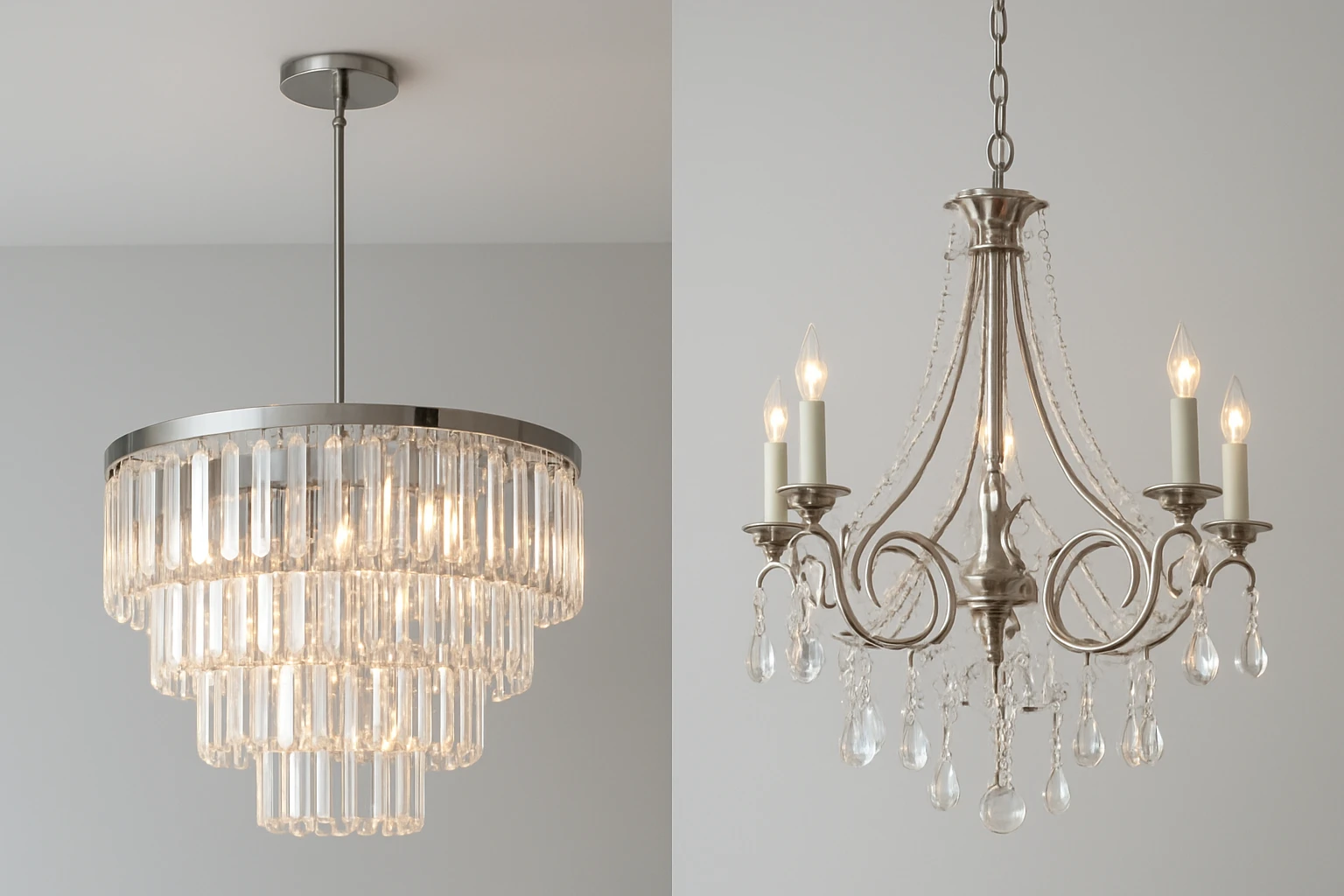
Summary: Modern crystal works by subtraction. Think slim rings, bars, rectangles, or geometric forms where crystal prisms, rods, or drops provide the light play while the frame stays disciplined. The effect is cleaner, brighter, and easier to pair with contemporary architecture.
Best for: Open-plan living spaces, newer homes, lofts, and dining rooms where you want sparkle without a lot of ornament. In a neutral room with pale oak, boucle upholstery, and black window frames, a streamlined crystal chandelier adds energy without introducing another decorating language.
Watch for: Harsh lighting temperature. A modern silhouette with icy bulbs can flatten the crystal and make the whole fixture feel clinical rather than luminous.
#4: A transitional crystal chandelier that bridges old and new
Summary: Transitional crystal sits in the most practical middle ground. It keeps some familiar cues — perhaps a softened arm, a more classic canopy, or warmer metal — but pares back the fuss. It often suits houses that have both older details and updated furniture.
Best for: Mixed-style rooms, renovated colonials, and open dining areas that connect visually to kitchens with shaker cabinets or matte black hardware. If your table is vintage but your chairs are clean-lined, this category often saves you from choosing sides.
Watch for: Designs that land in the mushy middle. Transitional should look deliberate, not undecided. You want clarity, not compromise for its own sake.
Which of the two works better in open-plan living spaces
Shades of Light lists modern & contemporary chandeliers and transitional chandeliers as separate categories, and LightsOnline divides crystal lighting into transitional and contemporary styles too. Online chandelier shopping often groups crystal fixtures by style family because the frame tells you how the piece will behave with the rest of the room.
In an open-plan space, modern usually wins when the architecture is spare and you want one crisp reflective note over a dining table or coffee area. Transitional works better when the room has mixed signals — say, a classic wood table, contemporary sofa, and older millwork all in one sightline. I would not choose by trend here. I would choose by what the chandelier has to talk to from across the room.
Crystal can look modern when the frame is simple and the sparkle is the main event.
#5–#6: Mini and drum crystal chandeliers
#5: A mini crystal chandelier for an entryway or nook
Summary: The mini chandelier is one of the most useful overlooked categories online. It gives you the personality of a larger fixture in a tighter diameter, often with a single tier, a petite basket shape, or a compact cluster of crystals that reads clearly from the doorway.
Best for: Apartment entries, small hallways, reading nooks, powder rooms, and narrow transitional spaces that need a point of view. In a Chicago condo, for example, a mini crystal fixture can give the foyer a memorable opening note without swallowing the ceiling line.
Watch for: Too much hanging chain or drop length. In small rooms, the fixture should feel precise. If it hangs low, it stops looking charming and starts feeling like an obstacle.
#6: A drum-shade crystal chandelier for softer, lower-profile sparkle
Summary: Drum-shade crystal chandeliers wrap the light source in a fabric or metal shade, then let crystal add texture and glow from inside or below. They feel softer than exposed-arm chandeliers and often sit more comfortably in rooms that need atmosphere rather than ceremony.
Best for: Bedrooms, breakfast rooms, smaller dining rooms, and spaces with lower ceilings where you still want polish. A drum shape can also tame brightness, which is helpful above a banquette or in a room used for early coffee and late homework.
Watch for: Dust and maintenance. Drum shades hide clutter visually, but they also make you notice when the shade fabric dulls or the crystal inside needs cleaning.
When compact designs outperform larger statement pieces
Shades of Light includes mini chandeliers and drum chandeliers in its main chandelier categories, while LightsOnline lists mini chandeliers and drum shade chandeliers & pendants separately. That split is smart. In a smaller room, the challenge is rarely “How do I make this big enough?” It is usually “How do I add character without making the ceiling feel busy?”
Retailers often pair crystal chandeliers with pendants in the same navigation to help shoppers compare shapes and scale. That is useful because a small room may not need the full visual footprint of a statement chandelier. But when you want that little flash of dressiness, mini and drum designs often beat larger fixtures by being controlled, intentional, and easy to live with day after day.
For small rooms, the best chandelier is often the one that looks intentional from the doorway and disappears from the floor plan.
#7–#8: Foyer and multi-tier crystal chandeliers
#7: A foyer crystal chandelier that anchors the entrance
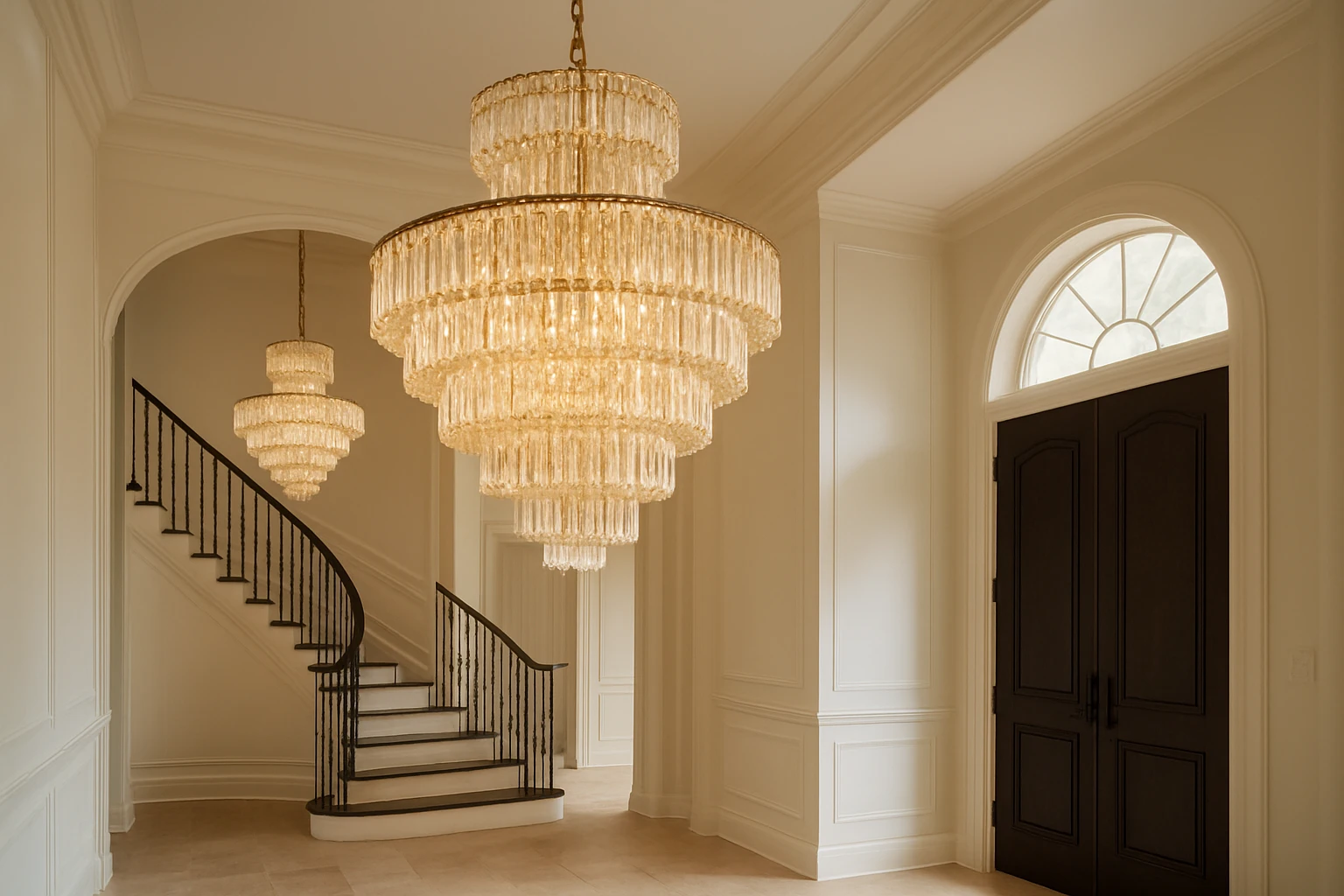
Summary: A foyer crystal chandelier has one primary job: announce the house with confidence. That does not always mean huge. It means the piece needs enough shape and light presence to hold the visual center of the entry, often against stairs, windows, and open sightlines.
Best for: Single-story entries, stair halls, and medium-height foyers where you want a clear focal point without committing to a cathedral-scale fixture. If your front door opens straight to a staircase, a moderately scaled crystal foyer light can pull the view upward immediately.
Watch for: Sightlines from the landing and from outside. A chandelier that looks fine from directly below may feel oddly small or awkwardly low when you approach from the stairs.
#8: A multi-tier crystal chandelier for grand vertical space
Summary: This is the dramatic vertical option — multiple levels of crystal or repeating stacked forms that use height as part of the design. It fills empty air honestly. In the right room, it creates that unmistakable “the house begins here” feeling.
Best for: Double-height foyers, tall stairwells, and large formal spaces that would make a smaller chandelier look apologetic. In an 18-foot entry, a multi-tier fixture can visually connect first floor, second floor, and ceiling line in one move.
Watch for: Assembly, maintenance, and patience. Large crystal pieces often require more hands, more time, and more planning than shoppers expect from the product page alone.
How to avoid under-scaling a big room
Shades of Light includes foyer chandeliers as a dedicated category, and LightsOnline includes multi-tier chandeliers and foyer lights in its navigation. That category structure matters because placement and height are not side notes here; they are the entire purchase. A crystal fixture that feels bold in a product photo can vanish when it has to compete with a sweeping staircase or a two-story wall of glass.
If the room is large, give the chandelier enough authority to occupy its airspace. I see more regret from under-sizing than from going slightly bold. A foyer is not a shelf vignette. It is architecture, and the fixture has to meet that scale head-on.
If the room is large, under-sizing the fixture is the fastest way to lose the drama.
#9–#10: Linear, island, and breakfast-room crystal chandeliers
#9: A linear crystal chandelier for a kitchen island
Summary: The linear crystal chandelier is a practical specialist. Instead of pushing all the sparkle into one round footprint, it stretches the light across a long surface. That could be a bar-like frame with crystal accents, a series of aligned drops, or an elongated structure that reads clearly over stools and countertop edges.
Best for: Kitchen islands, long dining tables, and any narrow rectangular surface where a centered round chandelier would leave dead space at both ends. Over a seven-foot island with three stools, a linear shape usually feels more intentional than a single clustered fixture.
Watch for: Sightlines across the kitchen. You do not want the fixture to interrupt the easy visual path between sink, range, and conversation area.
#10: A breakfast-room crystal chandelier for everyday dining
Summary: A breakfast-room crystal chandelier is the most livable kind of sparkle on this list. It tends to be smaller, friendlier, and less formal than a dining room piece, but it still brings enough shine to lift an eat-in kitchen above pure utility.
Best for: Banquettes, four-person tables, casual family dining spots, and kitchens where the table gets more use than the formal dining room ever will. This is where a soft crystal fixture can turn weekday coffee and homework into a slightly nicer ritual.
Watch for: Cleanup reality. Kitchens create grease film, and breakfast areas collect fingerprints, steam, and cereal-level chaos. Choose a shape you will actually clean.
Why elongated and room-specific shapes are easier to live with
Shades of Light includes island chandeliers among its chandelier categories, and LightsOnline groups crystal lighting into breakfast room chandeliers, kitchen island lights, and linear chandeliers & pendants as separate shopping destinations. That reflects a simple truth: in kitchens and casual dining spaces, geometry matters as much as glamour.
An elongated counter wants an elongated answer. A smaller round breakfast table wants a modest footprint that does not dominate everyday life. These are working rooms. You are carrying plates, helping with school forms, and reaching for the coffee grinder at 6:45 a.m. The best shape makes all of that easier while still catching the light when the room finally goes quiet.
In kitchens and breakfast rooms, the right shape matters more than maximum sparkle.
How to choose the right option
Measure width, drop, and walk-around clearance before you buy
Before you fall in love with a finish, take three numbers: target width, hanging drop, and clearance. Shades of Light features a design guide titled “How To Hang A Chandelier,” and that alone tells you something I wish more shoppers respected on day one — placement is part of the product. A chandelier is not done being chosen when you pick a picture.
For a dining room, I start with the table because it gives you honest boundaries. For a foyer, I care about what the fixture looks like from every approach angle, not just from directly below. For a small hallway, I test whether the piece will feel present from the doorway without becoming the first thing a tall guest notices with their forehead.
| Check before checkout | What to record | Why it matters |
|---|---|---|
| Width | Table size, island length, or open-floor span | Keeps the chandelier inside the room’s visual boundaries |
| Drop | Ceiling height and desired hanging height | Prevents a dramatic fixture from feeling low or lost |
| Clearance | Walk paths, stair views, and door swings | Protects comfort and avoids awkward everyday traffic |
Measure twice, then shop: width, drop, and clearance should decide the purchase before style screenshots do.
Match the fixture to the room’s function and traffic pattern
A chandelier above a formal table performs differently from one over a breakfast banquette. The dining room fixture can afford ceremony. The breakfast-room piece has to survive cereal, homework, and weeknight takeout. A foyer light is a first-impression tool. A kitchen island fixture works harder as a shape problem than as a decoration problem.
This is why room-specific navigation is so useful. LightsOnline breaks out breakfast room chandeliers, kitchen island lights, and foyer lights for a reason. Those labels reflect how people move through a home. If the room is busy, choose a shape that stays out of the way. If the room is mostly for arrival or occasion, you can ask the chandelier to do more visual heavy lifting.
Compare shipping, install guidance, and return terms across retailers
Online shopping lives or dies on the unglamorous details. LightsOnline advertises free shipping on orders over $49, which is a useful cue when you compare final cost rather than just the headline price. Install help matters too. A guide like “How To Hang A Chandelier” suggests the retailer understands the last ten feet between cardboard box and finished ceiling.
Brand breadth tells you something slightly different. A luxury page that lists names such as Luxxu, Masiero, Fine Art Lamps, Kalco, and Schonbek alongside Formenti and Boca Do Lobo shows how wide the market has become. You can chase ornate European drama or restrained contemporary sparkle. Just do not confuse abundance with clarity. Too many brands can slow your decision if the room itself is not already defined.
Before you buy, ask plain questions. How many boxes arrive? Do the crystals come attached or packed separately? What does the return window look like if the scale is wrong in person? Those answers are rarely as exciting as the finish close-up, but they are the answers you remember on delivery day.
Buy for the room first, and your chandelier will look smarter the minute it goes up.
That is the real shortcut with crystal chandeliers online in 2026: match the fixture to room type, ceiling height, and daily use before you compare sparkle or price.
Which space are you trying to change first — the entrance everyone notices, or the room your household actually uses every day?
Additional Resources
Explore these authoritative resources to dive deeper into crystal chandeliers online.
Explore Style With US MART NEW YORK
US MART NEW YORK offers online shopping for men’s, women’s, and kids’ fashion plus décor, gifts, complimentary shipping, easy returns, and app savings across the USA, UK, Europe, and Australia.
Shop New Finds- Editorial team


