How to Choose Home Goods Stores Online

How to Choose Home Goods Stores Online
Three browser tabs are open. A measuring tape lies beside your keyboard. On one screen, a store has the exact table lamp you want; on another, the return page is buried; on the third, a shipping calculator waits for your postcode.
You are not just picking a nice product photo. You are trying to decide which home goods stores online can actually deliver the right item, at the right price, to the right address without turning checkout into a customs puzzle. That is worth doing carefully. Recent style guides and retail roundups often cover a wide mix of categories, from decor to bedding and tabletop goods, with featured prices ranging from modest to premium.
So do not shop by mood alone. Use a short, repeatable process instead. If you buy for a flat in London, a house in Texas, an apartment in Berlin, or a family home in Sydney, the same rules apply: define the item, compare the store, verify the policy, then buy.
Prerequisites / Tools: Set your shopping brief before you browse
Before you judge any storefront, set your brief. This is the part most shoppers skip, and it is the reason so many carts fill up with things that looked right and fit nowhere.
Watch This Helpful Video
To help you better understand home goods stores online, we've included this informative video from Jenna Pierce. It provides valuable insights and visual demonstrations that complement the written content.
- A measuring tape
- Your postcode or ZIP code
- A rough budget
- A notes app, spreadsheet, or notebook
- A photo of the room you are shopping for
- Doorway, stair, or lift measurements for bulky pieces
List the room and item type first
Start with the room. Then get painfully specific about the item. “Bedroom refresh” is too vague. “Two standard pillow covers in rust velvet” is usable. “Cordless lamp for an entry console” is better. When you name the room and the item type first, you stop judging stores by beautiful homepage styling and start judging them by fit.
This matters because the market is broad. Retail roundups often jump from bedding to pillows, trays, candles, and pitchers. That variety tells you something simple: online home shopping is not one big category. It is a stack of smaller ones, and each store has strong and weak lanes.
Set your budget in local currency
Write your budget in the currency you will actually pay in: USD, GBP, EUR, or AUD. Do not hold a fuzzy mental number in one currency while shopping another. That is how a $229 sheet set quietly becomes a much larger final charge after exchange rates, taxes, and delivery.
The excerpted price range from style roundups is a good reminder of how wide this market runs. A $56 item at one end of the range and an $899 item at the other can both live under the label “decor,” but they belong to very different spending plans. You need to know where your ceiling sits before a store’s premium styling moves your goalposts.
Measure the space and note delivery constraints
Measure the footprint, height, and clearance around the item. Then measure access. A piece that fits the wall but not your stairwell is not a bargain. If you live in a walk-up, check turns on the landing. If you live in a building with a booking system for deliveries, note that too.
For smaller goods, think about use, not just dimensions. A tray can look generous in a studio shot and feel tiny on a real coffee table. A pendant may have the right diameter but the wrong drop length. The room decides more than the product page does.
| Brief Item | What To Write Down | Example |
|---|---|---|
| Room and item | Exact room, function, finish | Guest room, percale sheet set, white |
| Budget | Local currency and hard ceiling | £150 all-in |
| Measurements | Item size plus delivery access | Lamp height under 50 cm; box must fit lift |
| Delivery region | Country, postcode, import tolerance | Australia, Sydney metro, prefer duties shown early |
Start with your brief, not with a storefront: the right store is the one that fits your needs, budget, and delivery address.
Step 1: Match home goods stores online to the category you’re buying
Once your brief is clear, sort stores by category fit. This is the fastest filter you have.
Separate must-buy categories from nice-to-have items
Make two lists: what you must buy now, and what would be nice to add if the store turns out to be strong. This helps when you are shopping a lifestyle site that sells decor, gifts, accessories, and household items under one roof. A good extra item is fine. A weak main purchase is not.
- Must-buy now: the item you opened the tabs for
- Nice-to-have: add-ons such as candles, bowls, or gift items
- Ignore for now: categories outside your brief
If your main need is bedding, do not let a brilliant candle edit distract you. If your main need is tabletop lighting, do not overvalue a store’s artful props. Keep the primary category in first place.
Decide whether you need decor, bedding, or furniture
Different categories demand different levels of trust. Decor can be forgiving. A candle or tray is relatively easy to ship and return. Bedding depends on fabric feel, weave, and sizing. Larger home items add freight, damage risk, and access issues.
The variety in home retail listings makes this spread obvious: lighting, bedding, pillows, trays, candles, and pitchers are all in the mix. That means a store can look excellent in one slice and ordinary in another. A retailer with a tight bedding assortment may still be a strong choice for sheets, even if its general merchandise page feels thin.
Look for stores that are strong in your specific room or use case
Search within the store like a buyer, not a browser. Can you filter by room, size, color, material, and availability? Are there enough items in your category to compare within the site, or do you see four token products and a lot of styling fluff?
The top results in the provided search set lean heavily toward branded destinations and social content, not just neutral comparison pages. That is normal. It also means you need to do your own sorting. A big brand name or polished social feed does not tell you whether the selection is deep, the sizes are right, or the range is coherent.
A store can be excellent in one category and mediocre in another — do not assume the whole catalog is equally strong.
Step 2: Check whether the store actually serves your country
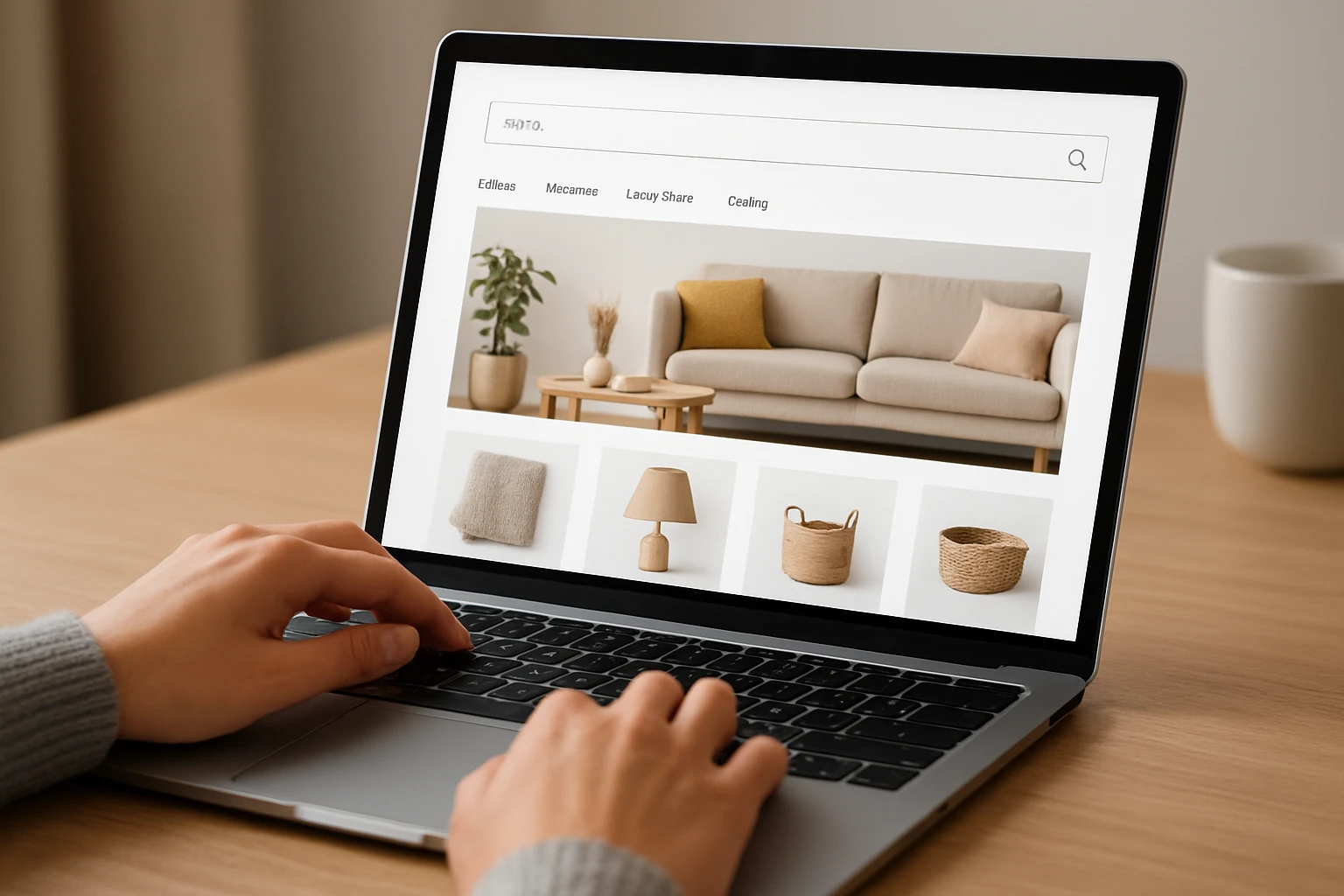
Style means nothing if the store will not ship to your region, support your currency, or explain import costs clearly.
Confirm shipping to the USA, UK, Europe, or Australia
Do this before you fall in love with a product. Look for a shipping page, country selector, or checkout postcode tool. If the site does not name your country, treat that as a real warning, not a small inconvenience.
For shoppers in the USA, UK, Europe, and Australia, eligibility is not a detail. It is a hard gate. Some stores ship only domestically. Some ship internationally but exclude bulky, fragile, or sale items. Others split rules by category, which matters when a marketplace-style site curates several labels under one roof.
Look for local currency, VAT, and customs clarity
If a store serves your country well, you will usually see one or more of these signs early: local currency display, tax or VAT guidance, an estimate of duties, or plain language explaining whether import charges are collected at checkout or on delivery.
Watch for the gap between product price and landed cost. An item priced neatly in dollars can look very different once shipping, VAT, or customs are added for a buyer in France or the UK. If those charges remain fuzzy until the last screen, you are carrying more risk than you think.
| Regional Check | Good Signal | Warning Sign |
|---|---|---|
| Country support | Your region appears in the selector or shipping page | No mention of your country until checkout fails |
| Currency | USD, GBP, EUR, or AUD shown clearly | Only one currency with no conversion guidance |
| Taxes and duties | VAT/customs explained early | “Charges may apply” with no estimate |
| Delivery calculator | Postcode tool or shipping estimate available | No clue on cost until account creation or payment page |
Make sure the site works before you invest time in browsing
This sounds basic, but it is worth saying because high rankings do not guarantee a smooth experience. In the provided search material, the first three reference excerpts were not usable at all, returning messages like “Something went wrong” or “Access Denied.” That is a useful lesson. A store or result can rank highly and still be difficult to evaluate.
Test the site quickly. Open a category page. Try a filter. Add an item to cart. Check the shipping page. If basic navigation is unstable, do not sink another 20 minutes into that tab.
If the store cannot show you the full cost to your country early, move on.
Step 3: Compare assortment depth, brands, and price range
The prettiest homepage is rarely the best store. Better stores win on range, curation, and pricing logic.
Look for breadth, not just a single hero collection
Many stores can stage one beautiful room. Fewer can support a real shopping mission. Look beyond the lead campaign images and count the practical options in your category. How many products are actually available? Are there multiple finishes, sizes, or fabric choices? Are core items in stock?
A strong assortment does not mean endless clutter. It means enough depth to make a decision without leaving the site. If you are shopping lighting, you want more than one photogenic item. If you are shopping bedding, you want size breadth, fabric choices, and clear care notes.
Compare entry-level, mid-range, and premium prices
Price spread tells you whether a store can meet you where you are. Retail roundups often show a simple example: a modestly priced item sits at one end of the range, while a premium statement piece sits much higher. Both can be valid. The question is whether the store gives you smart options between those poles.
If a site only offers premium statement pieces, it may be a great inspiration source but a poor everyday shop. If everything is suspiciously cheap and material details are thin, you may be looking at a quality problem dressed up as a bargain. The sweet spot is usually a store that offers one realistic buy, one step-up choice, and one aspirational piece without forcing you into another tab.
Favor stores with clear brand curation and recognizable partners
Curation saves time. A well-edited selection can mix smaller brands, industry favorites, and big-box stores with an elevated product array. That variety shows how useful recognizable partners can be when you are judging taste level and price logic.
You do not need famous names on every page. You do need evidence that somebody edited the catalog with a point of view. Clear brand partnerships, material consistency, and coherent styling usually beat a giant, messy product dump.
| Comparison Point | What Strong Looks Like | What Weak Looks Like |
|---|---|---|
| Assortment depth | Enough options within one category to compare size, finish, and price | One hero item plus filler |
| Price range | Entry, mid, and premium choices on one site | Only ultra-cheap or only aspirational pieces |
| Brand mix | Curated labels or credible in-house design direction | Random mix with no quality cues |
| Stock visibility | Availability shown clearly before checkout | Backorder surprise late in the process |
A good store should give you at least one realistic buy and one aspirational piece without making you leave the site.
Step 4: Read shipping, returns, and delivery details before checkout

Policies are not boring fine print. For home shopping, they are part of the product.
Check delivery windows and service levels
Start with the dispatch estimate. Then check the delivery method. Small decor items may ship by standard parcel service. Larger or fragile items can involve scheduled delivery, doorstep drop-off, or white-glove service. These are not interchangeable.
If you need something for a move-in date, holiday setup, or guest room refresh, the difference between “ships in 2 business days” and “made to order” is everything. Read those lines before you commit emotionally to the product photo.
Read the return window and restocking terms
Look for three things: how long you have, what condition the item must be in, and whether the store charges restocking or return shipping. For textiles, hygiene rules may narrow returns. For made-to-order items, cancellation may be limited. For sale merchandise, the item may be final sale even when similar full-price products are not.
International buyers should read even more carefully. Return windows, customs handling, and refund timing can change the real cost of a purchase. A low sticker price is not low-risk if sending the item back across borders costs nearly as much as keeping it.
Watch for oversized-item, damage, or white-glove fees
Bulky and fragile goods come with special rules. Check whether the store adds oversized surcharges, room-of-choice fees, packaging charges, or separate carrier costs for mirrors or other large items. Also read the damage procedure. Some stores ask for immediate inspection on delivery; others require photos before a claim can move forward.
That may sound fussy. It is not. It is practical. A great-looking piece with a weak damage policy is not really a better buy than a simpler piece with a fair one.
For big items, the return policy is part of the product — not an afterthought.
Step 5: Vet quality using product pages, materials, and reviews
Once a store passes the category and policy tests, look for proof that the item itself deserves your money.
Check materials and dimensions carefully
Serious stores tell you what the item is made of. That sounds obvious, but it is one of the cleanest ways to separate trustworthy sellers from weak ones. Product descriptions should be specific enough to give you something concrete to judge.
Read every dimension line, especially for tabletop pieces, general home items, and bedding. Check diameter, height, depth, and weight. For textiles, confirm the fabric type and care instructions. For lighting, confirm whether bulbs, shades, or charging parts are included. For home accents, note whether finishes are natural and likely to vary.
Use customer reviews and photos for reality checks
Reviews are most useful when they describe scale, color accuracy, assembly, or day-to-day use. One customer photo showing an item in an actual room can tell you more than six editorial shots. A review that says the color reads warmer, the fabric looks darker, or the item is smaller than expected is valuable because it anchors the listing in a real space.
If reviews are scarce, look for depth elsewhere: detailed specifications, care guidance, multiple product angles, and sensible FAQs. A curated retailer can still be trustworthy without thousands of reviews, but the page has to compensate with information.
Look for secure checkout and clear contact information
Before you buy, glance at the basics. Is the checkout secure? Is there a visible contact page, return process, and customer-service route? Can you find an email address, support form, or business location? If the site disappears behind vague language when you look for help, walk away.
Named retail environments can also act as a signal. The excerpt places retailers such as major department stores and specialist brands alongside each other, which suggests that curation and retail standards can matter as much as sheer category focus. You are not looking for prestige. You are looking for accountability.
If the page does not tell you what the item is made of, it is not a serious contender.
Common mistakes when choosing home goods stores online
Most bad purchases start the same way: the shopper evaluates beauty first and logistics second. Reverse that order and your hit rate improves fast.
Choosing by homepage style alone
A polished homepage is nice. It is not evidence. The top search results you were given include branded pages and social content, which are useful for inspiration but thin as buying proof. A strong aesthetic does not guarantee good filters, fair returns, reliable shipping, or even serious stock depth.
Think of the homepage as the shop window. You still need to inspect the shelves, the receipt terms, and the route home.
Ignoring the total landed cost
Product price is only one part of the bill. Shipping, VAT, duties, conversion, oversized fees, and return friction can change the decision completely. That matters most for cross-border buyers, but domestic shoppers get caught too — especially with larger home items.
If two stores sell similar pieces, choose the one that makes the full cost easiest to understand. Clarity is part of value.
Skipping regional support and policy pages
Do not assume a top-ranking result is easy to use. The provided reference set included unusable excerpts that showed “Something went wrong” and “Access Denied.” That is a blunt reminder that visibility and usability are not the same thing.
Always read the shipping page, returns page, and payment support before you invest real time. If the store hides them, or if the site feels unstable, you already have your answer.
Pretty homepage, weak policy page: that is a warning sign.
The best home goods stores online are the ones that fit your room, your budget, your region, and your risk tolerance — not just your taste.
Work in order: category fit, shipping eligibility, price range, policy quality, then proof on the product page. That sequence keeps a £56 impulse buy from turning into a costly mistake, and it keeps a premium statement piece from becoming a delivery nightmare.
When you open your next three tabs, what will you check first — the styling shot, the shipped-to cost, or the return page?
Additional Resources
Explore these authoritative resources to dive deeper into home goods stores online.
Fresh Style From US MART NEW YORK
Explore men’s, women’s, shoes, jewelry, accessories, beauty, home goods, electronics, sports items, no-charge delivery, simple returns, and app discounts for shoppers across the USA, UK, Europe, and Australia.
Shop Stylish Finds- Editorial team


